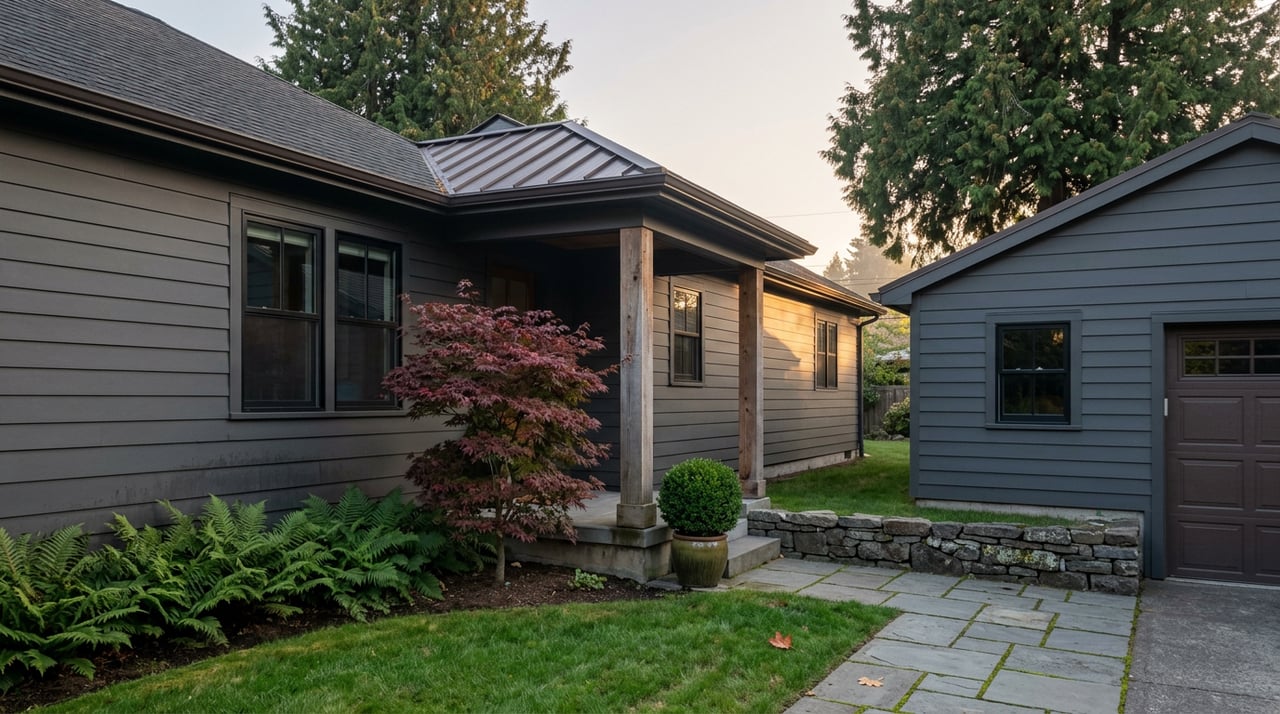
Redmond ADU HOA Rules 2026: The Date That Matters
September 10, 2026
September 10, 2026
A listing in Education Hill goes up this fall with a line agents love to add: "ADU potential." A buyer reads that, assumes Washington's 2023 accessory dwelling unit law settles the question, and starts penciling out a garage conversion before the ink on the purchase agreement is dry. Then title review turns up a homeowners association declaration recorded in 2011 that flatly prohibits any "additional dwelling" on the lot. The buyer's lender wants an answer. The buyer's contractor wants a start date. Nobody wants to hear that state law might not reach this particular HOA at all.
That gap between what the state changed and what a private covenant can still say is the real story here, and it's one most ADU explainers skip because it isn't flattering to the headline. Washington did not erase every HOA's power over accessory dwellings. It drew a line through the calendar, and which side of that line your Redmond HOA falls on determines whether the new rules apply to you at all.
House Bill 1337, Washington's 2023 accessory dwelling unit law, set a statewide floor for cities inside urban growth areas, Redmond included. Cities must allow at least two ADUs per residential lot, must permit detached units, cannot require the owner to live on site, and cannot cap unit size below 1,000 square feet. Redmond's own zoning code, RZC 21.08.220, reflects that floor directly: two ADUs or tiny homes per lot, attached or detached, a 1,000 square foot cap on the ADU and 400 square feet on a tiny home, and no owner-occupancy condition anywhere in the text.
Redmond has revised that code three times in under two years to keep pace with the state, most recently through Ordinance 3261, adopted June 2, 2026 and still working its way into the published code as of this writing. Before that came Ordinance 3220 in June 2025 and Ordinance 3186 in January 2025. The direction of travel has been consistent: fewer local restrictions, not more.
Part of that same 2023 legislation also stripped HOAs of the ability to prohibit ADU construction or rental on lots where the city would otherwise allow one. On paper, that sounds like a clean override. In practice, it comes with a cutoff.
The HOA override only reaches associations whose governing documents were created after July 23, 2023. If your HOA's declaration was recorded before that date and it already restricts "additional dwellings," "accessory structures," or similar language, the state law does not touch it. Washington chose not to reach backward into existing private contracts, so those older covenants remain enforceable exactly as written.
If your HOA's declaration was recorded before July 23, 2023, the state's new ADU rights run through your city's zoning code, not through your HOA's covenants.
That distinction matters because a city permit and an HOA's consent are two separate approvals. A Redmond building permit confirms your ADU meets the zoning code. It says nothing about whether your association can still bring a civil claim under a covenant the state never touched. Owners who assume a permit is the finish line sometimes learn otherwise after the framing is up.
Here's the mechanism laid out side by side:
| HOA formed before July 23, 2023 | HOA formed after July 23, 2023 | |
|---|---|---|
| Can the HOA prohibit an ADU outright? | Yes, if the recorded declaration already restricts additional dwellings | No, the restriction is unenforceable |
| Can the city still issue an ADU permit? | Yes, city approval is a separate process | Yes |
| Does the city permit protect the owner from the HOA? | No, the association can still pursue a civil claim | Not applicable |
| Do Redmond's two-unit, 1,000 sq ft rules apply either way? | Yes, under RZC 21.08.220 | Yes, under RZC 21.08.220 |
Here's the part that's easy to miss. The neighborhoods most likely to have an HOA formed before 2023 are also the ones with the most physical room to build an ADU. Education Hill, Grass Lawn, North Redmond, and Willows and Rose Hill are established single-family areas with backyards, detached garages, and the kind of lot depth a detached ADU actually needs. Those are exactly the places where a pre-2023 covenant, if one exists and restricts additional units, has the most to say.
Compare that to Redmond's newer growth centers. Downtown, Overlake, and Marymoor Village are the city's designated regional and countywide growth areas, built up with recent townhome and mixed-use construction. HOAs there are more likely to postdate July 2023, which means the state override actually reaches them. But those same properties tend to be townhome lots or attached product with little to no usable yard for a detached unit in the first place.
The legal protection and the physical opportunity don't line up. The lots with room to build often carry the HOA risk. The lots with the clearest legal path often don't have the space to use it.
This sits on top of a separate shift that already loosened Redmond's own zoning regardless of any HOA. Under the city's Neighborhood Residential rezone, effective January 1, 2025 and adopted to comply with Washington's middle housing law, R-1 through R-8 zones were folded into a single designation allowing up to six dwelling units per lot by right, and eight with an affordable housing bonus. The city's permissiveness isn't the bottleneck anymore. The HOA's paperwork is.
Before any of this becomes worth a covenant fight, it helps to know what's on the other side of the ledger. Garage conversion ADUs in the Redmond area typically run $100,000 to $180,000. Attached additions run $150,000 to $300,000. A detached new-construction unit runs $200,000 to $400,000. On the rental side, a studio ADU generally rents in the neighborhood of $1,450 a month, a one-bedroom closer to $1,800, and a two-bedroom $2,450 or more, depending on finish level and location.
Those numbers only pencil out if the unit can legally exist. Small, income-producing properties are already a narrow slice of Redmond's housing stock compared to single-family homes, condos, and townhomes, so a confirmed, unencumbered ADU right adds real value to a listing. An assumed one that a covenant search later voids can cost a buyer months and a contractor's deposit.
One more local wrinkle worth flagging early: if the spot you're eyeing for a detached unit holds a mature tree, Redmond requires a removal permit under RMC 21.72 for any tree six inches in diameter or larger, with replacement planting required. It's a smaller hurdle than the HOA question, but it's the kind of thing that surfaces late if nobody checks it early.
Does a Redmond building permit protect me if my HOA sues over an ADU? No. A properly issued permit confirms compliance with the city's zoning code. It doesn't affect a homeowners association's ability to enforce a covenant that predates the 2023 state override.
How do I find out when my HOA's governing documents were actually recorded? Request the recorded declaration through your title company or search King County's recording records directly. The recording date, not the subdivision's construction date, is what determines whether the state override applies.
If my HOA was formed after July 23, 2023, can it still limit short-term rental of an ADU? Yes. The state protects long-term ADU rights from HOA interference, but short-term rental is regulated separately. Redmond itself tightened its own short-term rental licensing rules effective January 1, 2026, on top of whatever an HOA might separately require.
Does the same logic apply to condominium associations? The statute is different for condominiums, but the underlying question is the same: when were the governing documents created, and what do they say about additional units. That date-driven analysis doesn't go away just because the property type changes.
If you're weighing a Redmond purchase with ADU plans in mind, or you're selling a property where that potential is part of the pitch, the covenant history is worth confirming before it becomes a surprise. Deborah Song works through exactly this kind of due diligence with buyers and sellers across Redmond and the Eastside. Let's Connect.
Stay up to date on the latest real estate trends.
Connect with a real estate professional who values trust, insight, and personal attention. Every step is guided by a deep understanding of what “home” truly means.